
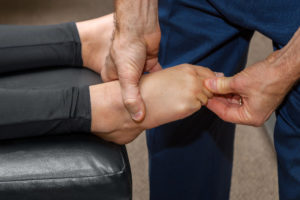
 Physical examination is very important when evaluating cervical radiculopathy and determining which nerve root is affected. During this exam, performing manual muscle testing can be done to detect subtle weaknesses. To do this, the doctor will place the limb of the side that is affected in the antigravity position and then apply resistance in the area that is proximal to the distal joint.
As an example, if the doctor wants to test the extensor carpi ulnaris muscle, they will have the patient fully pronate their arm and rest it on a table, or support the arm. The doctor will then instruct the patient to extend their hand and deviate it toward the ulnar side. Applying resistance against the dorsum of the fifth metacarpal bone gives the doctor surface area. Then the doctor can grade the muscle strength on a scale of 0 to 5.
Partnering in the Treatment of Radiculopathy
Physical examination and a patient’s medical history are key in diagnosing sciatica. This will help the doctor to be able to identify the pain pattern in a patient’s leg. Typically, sciatica follows the areas of the skin supplied by the sciatic nerve. These areas are called the dermatome. The pain can also include other deeper tissues. In addition to doing muscle testing during a physical examination, a doctor may also check for localized pain in the leg, thigh, buttock, and low back, the response to leg movements that elongate the nerve, and the response to certain stimuli.
Once the physical examination and review of medical history occurs, the doctor may wish to do medical testing. An MRI, discogram, or EMG/NCS testing also shows changes. Putting all of these pieces together can help the doctor pinpoint where the pain is coming from. This creates the best course of treatment. A physical exam including manual muscle testing, a review of medical history, and medical testing are all great tools to help the patient.
Our Case Facilitators
 Esteban Galvez
 George Santos
 Melanie Greene
